AI safety: Artificial intelligence keeps getting bigger every year and everyone is calling it the most powerful technology of our generation. But with this huge power also comes huge risk which many people don’t talk about openly. Recently a new research report came out and it straight up said that most AI companies are not meeting global AI safety benchmarks. This raised a lot of questions because the world is depending on AI for everything now from business to healthcare to national security. If the safety part is weak then it simply means we are building something fast without checking if the foundation is strong enough.
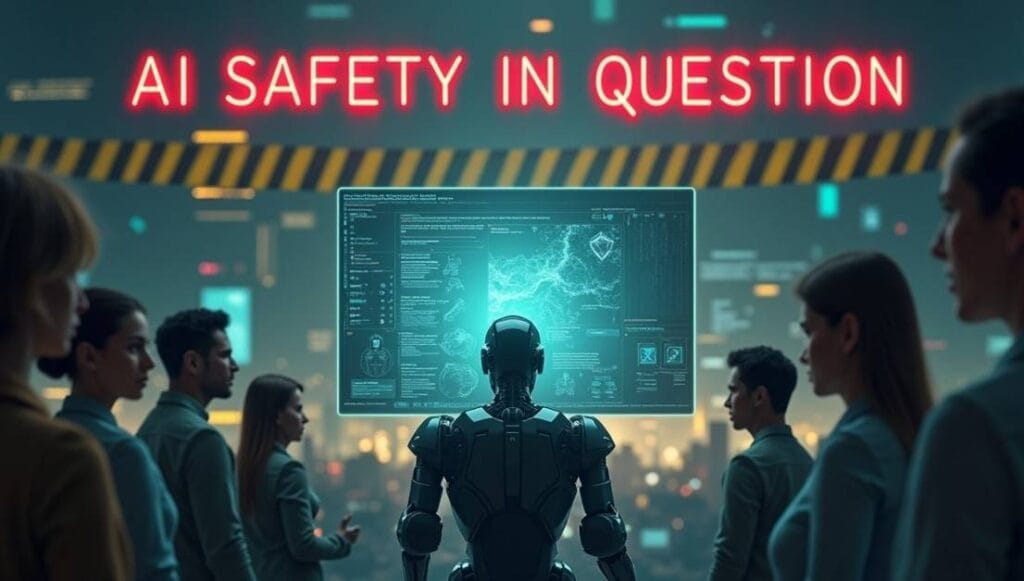
The study did not attack any company directly but it clearly pointed out that the industry as a whole is moving too fast while safety development is moving too slow. This gap is creating worry among global regulators and even common users because everyone is using AI daily for work entertainment decision making learning almost everything. When a system this powerful grows without matching safety standards then the risk becomes bigger with time and not smaller.
Most people believe AI companies have huge research teams and advanced testing labs so they must be safe. But the study shows a different story. It says many companies only follow internal rules and not international benchmarks. That means every company decides on its own how safe its AI should be. This approach works when the tool is small but not when the tool can generate content influence people create deepfakes and even guide automation tasks.
The growing concern around AI safety
AI has already reached a point where it can generate realistic images voices videos codes even decisions. And users often cannot differentiate what is real and what is AI made. This confusion can easily create misinformation and manipulation. Today a single AI model can produce thousands of fake posts or deepfake videos in minutes which can be used for scams elections fraud or harassment.
Because of this global safety bodies have created some common guidelines. These include red teaming risk testing privacy protection transparent model behavior secure data training and audit reporting. But the new research shows many AI companies are still not following these benchmarks fully. Some follow a few parts some ignore many of them and some companies do not even publish their safety reports.
This lack of transparency is a huge red flag according to the study. When companies hide key information like how they train the model or what risks they discovered it means outsiders have no way to check how safe or unsafe the system truly is.
Another big issue the study points out is rushed releases. AI companies are in a race to launch the biggest and smartest model before competitors. In this race AI safety sometimes becomes a second priority. When a feature is ready for marketing but not fully tested for risks it still gets pushed out. This is happening across the industry.
Why global benchmarks matter so much
AI is not like normal software. A simple line of wrong code in AI can affect millions of users at once. And because AI models can learn from new data and behave differently over time the safety checks must be constant not one time. This is why global AI safety benchmarks were created to make sure every company is following the same minimum rules.
But the study says something surprising. Many companies believe their own internal rules are enough. They think global guidelines slow down innovation. Because of this many skip important steps like external audits third party testing or publishing safety research.
Global benchmarks basically make sure that AI behaves in predictable ways does not hide harmful behaviors and stays aligned with human values. Without these checks AI systems can show bias. They can amplify harmful content. They can respond unpredictably in edge cases. And they can be misused by attackers.
The study mentions that some companies test AI only on ideal conditions not real world messy situations. This makes the safety score look better than it actually is. When the tool goes public it suddenly interacts with millions of unpredictable user inputs which may trigger harmful outputs the company did not prepare for.
This is exactly why global benchmarks insist on stress testing and real world simulation. But many AI companies skip it because it takes time money and access to large evaluation datasets.
Pressure from investors vs pressure from regulators
Another thing the report quietly highlights is the conflict inside AI companies. On one side investors want fast releases quick growth new features every month and large user adoption. On the other side regulators ask for careful testing slower rollout and transparent safety reporting.
Most companies end up prioritizing investor expectations because growth is directly related to funding and valuations. And when the pressure increases safety teams may feel less support or less time to perform deep evaluations. This imbalance is visible in the final results. The study says this is one of the major reasons why companies fail to meet global safety standards.
Governments around the world are now noticing this pattern. Many countries including the US UK EU India Japan are working on AI rules and AI safety laws. But the problem is laws move slow while AI moves extremely fast. When laws arrive the technology has already moved to the next generation releasing new problems. This creates a constant gap.
Real world risks when safety is not strong
If AI companies miss safety benchmarks several things can go wrong. The study lists some of the biggest risks.
1. Misleading or harmful content
AI can produce confident but incorrect answers which can misguide users. In medical financial or legal situations this can be extremely risky.
2. Deepfakes
Fake videos and voices are becoming so real that common people cannot differentiate. This can be used for blackmail political drama and online harassment.
3. Scams and fraud
Attackers are now using AI to write scam messages generate fake identities break passwords or mimic someone’s voice. Weak safety makes this easier.
4. Automation failures
If AI is used in business operations or industrial automation a safety failure can shut down systems or create large losses.
5. Bias and discrimination
Many AI models still show bias in responses. They may, unintentionally. discriminate against certain groups due, to flawed training data.
6. Privacy concerns
Some models memorize sensitive information from training data. Without strict safety rules this information can leak through generated outputs.
When companies do not follow global safety benchmarks these risks increase. The study says the industry needs to move from optional safety to mandatory safety if we want to control long term damage.
What the study recommends for the future
The researchers say the solution is not to slow down innovation but to make safety a parallel priority. They suggest some important changes.
Transparent reporting
Companies should share how their models were tested what risks were found and what corrections were applied.
Independent audits
AI Safety checks should not be done only by internal teams. Third party experts should verify the results.
Better red teaming
Models must be tested against harmful prompts tricky edge cases and misuse scenarios before release.
User awareness
People should know what AI can and cannot do. Clear warnings can prevent misuse and blind trust.
Government guidelines
Regulators should create clear rules so companies know exactly what safety standards they must meet.
Slow release strategy
Instead of launching a powerful model globally on day one companies should release it in small controlled phases.
The study ends by saying that AI is here to stay and will become even more powerful. So the earlier we fix the AI safety issue the better it is for everyone.
CHECK: AWS re:Invent 2025 Brings Powerful Agentic AI Updates for Developers
Final thoughts
AI is changing the world at a speed no one expected. Every month new models come new updates come new features drop. But somewhere in this excitement the safety question keeps getting ignored. The latest study simply exposes a gap which many experts already feared. AI companies are growing faster than AI safety.
If global AI safety benchmarks are not followed then AI may create problems that we discover only after too much damage is done. The solution is not fear or strict control. The solution is balance. Innovation and safety must go together like two wheels of the same vehicle.
Users trust AI blindly. Businesses depend on it. Governments rely on it. So the companies creating these systems must take responsibility and follow global standards without excuses. Because if the foundation is weak even a small mistake can shake the entire structure.
AI is powerful. But power without safety is always a risk. And this study is a reminder that we still have a lot of work to do for AI safety.
Question Answer
1. What is AI safety?
Making sure AI systems behave safely without causing harm or misuse is AI safety
2. What is the 30% rule in AI?
A guideline suggesting AI models should reduce risk by at least 30% before release or deployment.
3. How can AI be used in safety?
AI safety can detect threats, monitor systems, prevent errors, and assist in faster decision-making.
4. What are the goals of AI safety?
Goals of AI safety are to Reduce harm, ensure control, prevent misuse, and keep AI aligned with human values.

 By
By