“AI in 2026″Artificial intelligence is no longer a future promise. It is already here. By 2026 AI will feel less like a tool and more like a silent partner working in the background. Many people still think AI means chatbots or image generators. That idea is outdated. The next phase is deeper quieter and more practical. This shift will not be loud. It will be subtle. And that is what makes it powerful.
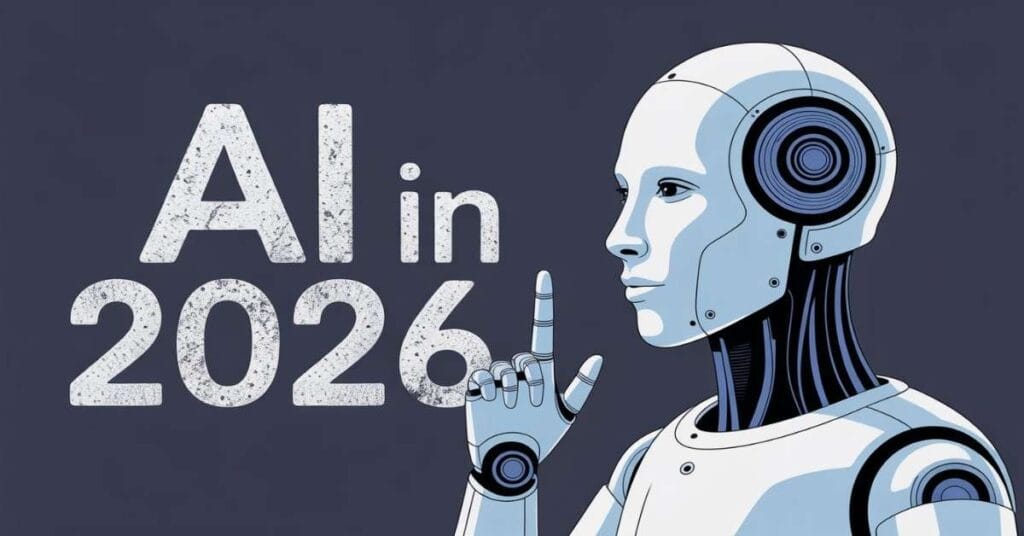
In 2026 AI will stop trying to impress. It will start trying to work. That single change will shape everything.
AI moves from experiments to everyday systems
In earlier years companies tested AI like a side project. Proof of concepts. Pilot programs. Fancy demos. In 2026 this phase fades. AI becomes part of core systems. Banking healthcare logistics education. It will sit inside workflows without announcements.
A loan gets approved faster. A medical report is generated sooner. A supply chain adjusts before a shortage happens. People may not even realize AI is involved. That is the real win.
This is not hype driven AI. This is boring reliable AI. And businesses love boring when it works.
Agent based AI takes control of tasks
One of the biggest changes in AI in 2026 is the rise of autonomous AI agents. These are not simple assistants. They do not wait for every instruction. You give a goal. They plan. They execute. They adjust.
For example a marketing team sets a target. Increase website traffic. The AI agent studies data runs tests changes content monitors results and reports back. No micromanagement. No constant prompts.
This feels uncomfortable for many people. Giving up control always does. But productivity gains will force adoption. Slowly then suddenly.
AI becomes deeply personalized
Generic AI responses will feel outdated by 2026. People will expect systems that understand context history and preferences. Not in a creepy way. In a useful way.
Your AI assistant will know how you work. When you work best. How much detail you like. Whether you prefer direct answers or explanations.
In education AI tutors will adapt to each student. Fast learners slow learners visual thinkers. One classroom. Many paths.
Personalization becomes the default expectation.
Multimodal AI becomes normal
Text only AI already feels limiting. In 2026 AI systems will seamlessly understand text images video audio and real world signals together.
You can show an image explain a problem speak instructions and get a combined response. No switching tools. No friction.
This matters most in fields like healthcare manufacturing and design. A doctor uploads scans and voice notes. The AI connects everything. A factory manager shows a machine issue via video. The AI diagnoses it. this is ai in 2026
This is not futuristic. It is practical.
AI reshapes jobs not eliminates them
The fear is always the same. AI in 2026 will take jobs. The reality in 2026 is more complex.
Yes some repetitive roles will shrink. Data entry. Basic analysis. Simple customer queries. That shift is already happening.
But new roles grow faster. AI supervisors. Prompt designers. Workflow architects. Ethics reviewers. People who understand both domain knowledge and AI behavior.
Most jobs will not disappear. They will change shape. Those who adapt will move ahead. Those who resist will feel stuck.
Learning becomes continuous. Degrees matter less. Skills matter more.
Decision making becomes AI assisted
In 2026 major decisions will rarely be made without AI input. Not because humans are weak. Because data is too large.
Executives will still decide. Doctors will still diagnose. Judges will still judge. But AI will provide simulations predictions and risk assessments.
This does not remove responsibility. It increases it. You can no longer say you did not know. The data was there.
AI in 2026 becomes a mirror. It shows possibilities. Humans choose.
Regulation finally starts catching up
For years AI moved faster than laws. That gap creates chaos. By 2026 governments take a firmer stance.
Not blanket bans. Not wild freedom. Structured frameworks.
Expect rules around data usage transparency and accountability. Especially in finance healthcare and public services.
Companies that prepared early will benefit. Those who ignored ethics will struggle.
Regulation will not kill innovation. It will filter it.
Trust becomes the new currency
In the early AI boom everyone focused on capability. Faster models bigger systems more features. In 2026 trust matters more.
Users will ask simple questions. Can I rely on this. Can I explain its decision. Who is responsible if it fails.
AI systems that cannot answer these questions will lose adoption. Especially in sensitive sectors.
Explainable AI moves from research papers to real products.
AI and creativity find balance
There was panic that AI would replace writers designers musicians. That panic cools down by 2026.
AI becomes a creative partner. Not a replacement. It handles drafts variations and experimentation. Humans bring taste judgment and emotion.
The result is more content. Better content. Faster cycles.
Originality still matters. Vision still matters. AI just removes friction.
Small businesses gain unfair advantage
Earlier advanced technology favored big corporations. AI flips this dynamic.
AI in 2026 small teams use AI to compete with large firms. Automation marketing analytics customer support. All accessible.
A five person startup can operate like a fifty person company. That changes markets.
Innovation spreads. Competition increases. Consumers win.
AI energy concerns push efficiency
Training massive models consumes power. This reality cannot be ignored. By 2026 efficiency becomes a priority.
Smaller specialized models gain popularity. On device AI grows. Edge computing expands.
The goal shifts from biggest model to smartest deployment.
Sustainability becomes part of AI strategy not an afterthought.
Human skills gain new value
Ironically as AI grows human traits become more valuable. Critical thinking empathy creativity leadership.
AI can process information. It cannot care. It cannot inspire. It cannot take moral responsibility.
Organizations will actively look for people who complement AI rather than compete with it.
This is the quiet redefinition of intelligence.
The future feels normal
The biggest surprise of AI in 2026 is how normal it feels. No dramatic moment. No sudden takeover.
Just gradual integration. Day by day.
People stop asking what AI can do. They start asking how they worked without it.
That is how real change happens.
CHECK: Walmart’s AI Strategy Explained What Is Working in Reality
Final thoughts on AI in 2026
AI in 2026 is not about machines becoming human. It is about systems becoming useful. Reliable. Invisible.
The winners will not be those who chase every trend. They will be those who understand where AI fits and where it should not.
The future is not automated. It is augmented.
And it is closer than most people think.

 By
By